Blanca’s bereavement
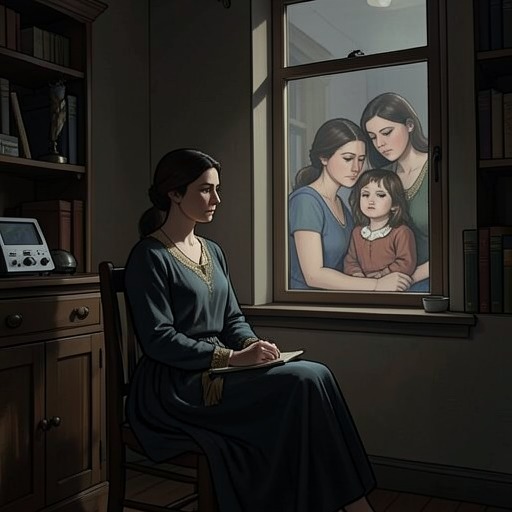
También esto pasaráBlanca’s bereavement begins in the disorienting fact that her mother has died while Blanca is forty, an age she had never imagined reaching. It does not advance as a smooth passage from pain to recovery. The funeral, the silence of the family house, the children’s routines, physical contact, and memories of Cadaqués repeatedly draw her toward and away from the loss. Her mother’s absence becomes a changed presence: painful in the rooms and objects she has left behind, but still active in Blanca’s habits, memories, and imagined encounters.
The first shock
At the funeral, Blanca measures the present against the future she once pictured. At twenty, she imagined herself at thirty with the love of her life and children, and at sixty making apple pies for grandchildren; she never pictured herself at forty, much less fifty. Now she is forty and at her mother’s funeral, overwhelmed by heat, exhaustion, sadness, and nausea. Even her clothes seem irrecoverable, soaked through with grief and fatigue. Her inability to recognize how she arrived at this moment gives bereavement its first shape: the death is a fact, but its emotional reality has not settled.
The gathering is marked as much by absence as by attendance. Friends of her mother and Blanca’s friends have come, but illness had alienated people, and Blanca reflects on the burden her mother’s declining happiness placed on her. She had distanced herself when she feared that the collapse of her mother’s world would also destroy her. Still, she believes her mother loved her, and dwells on how blunt, unqualified love can be more trustworthy than affection softened by a reassuring intensifier. Grief therefore carries anger and uncertainty alongside attachment; it cannot be reduced to either an idealized account of the dead or a simple indictment of the living relationship.
Carolina notices that Blanca is close to fainting and takes her by the arm to a wall overlooking the sea, away from the funeral crowd. The gesture gives Blanca a brief refuge from the public occasion and its expectations. The ceremony itself lasts about twenty minutes. In accordance with her mother’s prohibition on funeral poems, there are no speeches or poems, and there are also no prayers, flowers, or music. The only spoken words come when the elderly workers nearly drop the coffin. The starkness of the ritual does not make the loss easier to absorb: afterward, Carolina takes Blanca’s hand as they descend the hill, and Blanca repeats to herself that her mother is dead. She considers making Cadaqués her official home now that the house there belongs to her.
Relief, routine, and the return of pain
The novel places bodily consolation beside bereavement without suggesting that one cancels the other. After the funeral, Blanca wakes beside her ex, Óscar. Sex has, for a few moments, swept away death and life alike; then the room, the clothes, the memories, panic, and sorrow return to their exact places. The children’s cries from the swimming pool and the calm trees outside the window belong to a world continuing without regard for the disaster Blanca has experienced. The contrast makes relief real, but brief.
Later, people tell Blanca that many love her. She appreciates the reassurance but cannot take it in: she wants to retreat to bed and be left alone, with her mother beside her, holding her hand and touching her forehead. The comfort offered by the living cannot reproduce that particular intimacy. When she travels to Cadaqués with the children, they arrive late and are carried, half asleep, to bed. Blanca finds a missed call from Tom but does not return it, believing he is looking for someone else. At night, grief becomes a prowling inner howl that keeps her awake; daytime brings children and daily tasks that quiet it for a while, but the solitude of night allows it to return.
The house as a store of memory
Early in Cadaqués, Blanca goes to the terrace and looks at the sea. Memories gather densely, but on this occasion they do not suffocate her. The family house holds the accumulated texture of a shared life: fruit brought from Barcelona, Marisa’s gazpacho, long breakfasts, beach towels drying on the railing, reluctant naps, evening ice creams, and card games. Its history also includes first drunkenness, first love, sleepless nights, summer friends, and the conception of Blanca’s first child. Later came visits with children, separations, her mother’s old age, and the gradual closing of doors that had once been left open even at night.
The unchanged landscape creates a difficult counterpoint to that history. In the morning, the clear air, rose-white light, and still sea seem to deny the tragedies that have accumulated in the house. For an instant, if Blanca did not look back, life might appear to be beginning as it did when she was twenty. But the memories also include the mother’s decline and the house aging until it seemed to become an extension of her. The place is refuge and archive at once: it preserves the pleasures of a family life, but makes its ending impossible to ignore.
The mother’s gaze and the need for touch
After her mother’s death, Blanca finds that even books, once central to their relationship, have become difficult to open. They recall her mother’s library, her annual cleaning of its shelves, and their trips to London in search of illustrated books. Her mother had paid close attention to how a person looked at, opened, and turned the pages of a book. Such details make reading inseparable from the lost observer who shared it with Blanca.
Their intimacy had never depended on telling one another everything. They were not confidantes, and each tended to present a more composed self to the other. When Blanca once disclosed that she had already had her first period for two years without telling her mother, her mother stopped the car in astonishment; after the traffic behind them began honking, she drove on, and the subject was never raised again. Blanca had also kept her love life at a distance, even as her mother watched her fall in love, suffer, and recover without intervening heavily. In retrospect, Blanca understands her mother’s love as foundational to the later loves in her life, including her fierce love for her children.
A pedicure in the village offers a small, immediate form of consolation. As the beautician massages her feet, Blanca recognizes that since the death, even fleeting or casual physical contact has eased her distress. Yet the loss that hurts most is the loss of being seen by her mother. Blanca’s sense of place in the world had seemed secure in her mother’s gaze; now she feels orphaned at forty, with children, two marriages, relationships, homes, and work behind her, and wonders whether adulthood must follow childhood rather than old age. The passage from one identity to another is itself part of her grief.
Absence, imagined presence, and continuation
The mother’s absence is also registered by Patum. The dog no longer enters the mother’s room but waits at the door, sniffing for her scent or some sign that she will return. Blanca recognizes her own search in this vigil. She remembers the litter born in the house: nine puppies, one of whom died within hours, and her mother’s weeks of tending the survivors in a wooden box beside her bed. The memory of her mother caring for the weakest puppies gives the house’s past a tenderness that sharpens Blanca’s fear of losing Patum, whom the veterinarian believes may not live through the winter. The dog, the mother, and the summer home together make the family’s diminishing presence tangible.
Near dawn, after leaving a party, Blanca sets out toward the cemetery, imagining that she might finally visit alone. The gate is locked. She pushes and rattles it, calls softly to her mother, then pounds on it until her hands hurt. As daylight comes, she sits exhausted by the entrance and looks across the olive fields toward Port Lligat. There she imagines her mother walking along the quay in her bathing suit and faded checked shirt, with Patum, Nana, and Luna after a swim, on her way to the boat. The remembered figure turns, smiles, and offers the assurance that this too will pass. The scene does not undo the failed visit or establish that the mother has literally returned; it gives Blanca an image through which she can bear the morning.
By the epilogue, Blanca is breathing more easily and having fewer nightmares, though the feeling of happiness still arrives only occasionally. Her children continue to greet visitors with kindness and respect, and her older son silently looks toward his grandmother’s balcony when they pass her last apartment on Carrer de Muntaner. Blanca does not tell him that his grandmother is in a better place, because she knows how much his grandmother loved being with him and Blanca. The continuing bond is carried instead by memory, family gestures, and objects: Blanca takes her mother’s jacket to the dry cleaner and is told it will come back as good as new. The ordinary errand is not a replacement for the dead woman. It is one way the bereaved daughter begins to live among what remains.